New XK0-006 Mock Exam | Pdf XK0-006 Torrent
Wiki Article
What's more, part of that TestValid XK0-006 dumps now are free: https://drive.google.com/open?id=1yschbUGemBvvEH9mB1bgDenf97Du2o54
Perhaps you do not understand. Anyway, what I want to tell you that our XK0-006 exam questions can really help you copyright faster. Imagine how much chance you will get on your career path after obtaining an internationally certified XK0-006 certificate! You will get a better job or get a big rise on the position as well as the salary. And we can claim that if you study with our XK0-006 study materials for 20 to 30 hours, you will copyright with ease.
CompTIA XK0-006 Exam Syllabus Topics:
| Topic | Details |
|---|---|
| Topic 1 |
|
| Topic 2 |
|
| Topic 3 |
|
| Topic 4 |
|
Pdf XK0-006 Torrent | New XK0-006 Test Simulator
Are you staying up for the XK0-006 exam day and night? Do you have no free time to contact with your friends and families because of preparing for the exam? Are you tired of preparing for different kinds of exams? If your answer is yes, please buy our XK0-006 Exam Questions, which is equipped with a high quality. We can make sure that our XK0-006 study materials have the ability to help you solve your problem, and you will not be troubled by these questions above.
CompTIA Linux+ Certification Exam Sample Questions (Q135-Q140):
NEW QUESTION # 135
Which of the following passwords is the most complex?
- A. H3sa1dt01d
- B. he$@ID$heTold
- C. H3s@1dSh3t0|d
- D. HeSaidShetold
Answer: C
Explanation:
Password complexity is a fundamental concept within the Security domain of CompTIA Linux+ V8. Complex passwords significantly reduce the risk of successful brute-force, dictionary, and credential-stuffing attacks.
Linux+ emphasizes evaluating passwords based on length, character variety, unpredictability, and resistance to common word patterns.
Option C, H3s@1dSh3t0|d, is the most complex password among the choices. It demonstrates strong security characteristics by incorporating:
Uppercase letters (H, S)
Lowercase letters (s, d, t)
Numbers (3, 1, 0)
Multiple special characters (@, |)
A longer overall length compared to some other options
Additionally, option C uses character substitution (leet-style) in a way that breaks up recognizable words more effectively than the other choices. This significantly increases entropy and makes the password harder to guess using rule-based or hybrid cracking techniques.
Option A includes uppercase letters and numbers but lacks special characters and is relatively short. Option B includes special characters and mixed case, but it still closely resembles readable words, making it more susceptible to dictionary-based attacks. Option D uses only alphabetic characters and clear word patterns, making it the weakest choice.
Linux+ V8 documentation highlights that the strongest passwords combine length with diverse character classes and minimal predictability. Password C best meets all of these criteria and would score highest against common password-cracking strategies.
Therefore, the correct answer is C. H3s@1dSh3t0|d.
NEW QUESTION # 136
A systems administrator wants to review the logs from an Apache 2 error.logfile in real time and save the information to another file for later review. Which of the following commands should the administrator use?
- A. tail -f /var/log/apache2/error.log | tee logfile.txt
- B. tail -f /var/log/apache2/error.log | logfile.txt
- C. tail -f /var/log/apache2/error.log >> logfile.txt
- D. tail -f /var/log/apache2/error.log > logfile.txt
Answer: A
Explanation:
Using tee allows output to be viewed in real time on the terminal while simultaneously writing it to logfile.txt. This meets both requirements: monitoring live updates and saving them for later review.
NEW QUESTION # 137
A systems administrator is investigating bandwidth issues on a Linux file server that should be able to easily exceed 12.5MBps. The administrator inspects the following information: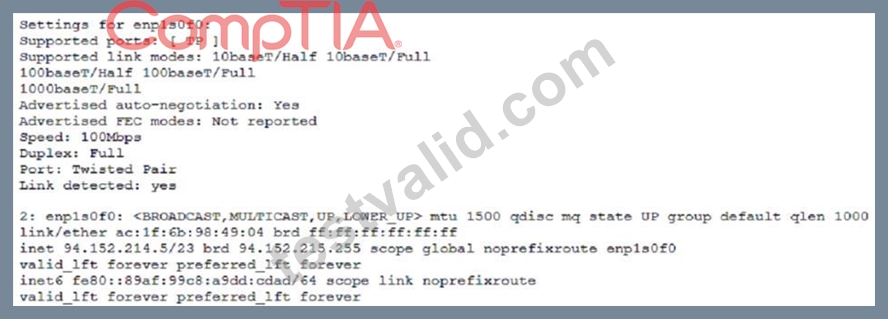
Which of the following is causing the bandwidth issue?
- A. The network interface enp1s0f0 has the incorrect queue length configured
- B. The network interface enp1s0f0 is not using FEC mode
- C. The network interface enp1s0f0 has misconfigured the MTU value
- D. The network interface negotiated speed for enp1s0f0 is set too low
Answer: D
Explanation:
The interface has negotiated a speed of 100Mbps, which caps throughput to around 12.5MBps under ideal conditions. If the server should exceed that, the link is negotiating at a lower-than- expected speed (for example, it should be at 1Gbps or higher).
NEW QUESTION # 138
A systems administrator receives reports from users who are having issues while trying to modify newly created files in a shared directory. The administrator sees the following outputs: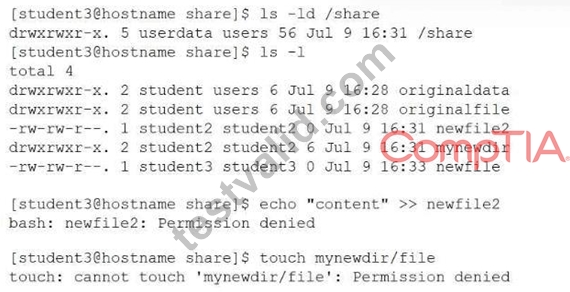
Which of the following provides the best resolution to this issue?
- A. Changing all directory contents to be writable and readable for everyone
- B. Adding a setuid bit to the user in the shared folder
- C. Manually changing the group of the newly created files
- D. Adding a setgid bit to the group in the shared folder
Answer: D
Explanation:
This scenario involves shared directory collaboration, which is a common system management task covered in the CompTIA Linux+ V8 objectives. The key issue is that users can create files in the shared directory, but other users in the same group cannot modify those files. This behavior is directly related to group ownership inheritance.
By default, when a user creates a file or directory, it is owned by the user and assigned the user's primary group, not necessarily the group of the parent directory. As shown in the output, files inside /share are owned by different groups (student, student2, student3), which prevents other group members from modifying them, even though the parent directory is group-writable.
The correct solution is to set the setgid (set group ID) bit on the shared directory, making option D correct.
When the setgid bit is applied to a directory, all newly created files and subdirectories inherit the group ownership of the parent directory, rather than the creator's primary group. This ensures consistent group ownership and allows all members of the shared group to collaborate effectively.
The other options are incorrect or poor practice. Option A (setuid) is intended for executables, not directories.
Option B requires constant manual intervention and does not scale. Option C weakens security by granting write access to all users, violating the principle of least privilege.
Linux+ V8 documentation explicitly recommends using the setgid bit on shared directories to manage collaborative access securely and efficiently.
NEW QUESTION # 139
A systems administrator is configuring new Linux systems and needs to enable passwordless authentication between two of the servers. Which of the following commands should the administrator use?
- A. ssh-keygen -t rsa && ssh-copy-id -i ~/.ssh/id_rsa.pub john@server2
- B. ssh-add -t rsa && scp -rp ~/.ssh john@server2
- C. ssh-keyscan -t rsa && ssh-copy-id john@server2 -i ~/.ssh/key
- D. ssh-agent -i rsa && ssh-copy-id ~/.ssh/key john@server2
Answer: A
Explanation:
Comprehensive and Detailed 250 to 350 words of Explanation From Linux+ V8 documents:
Passwordless authentication using SSH key pairs is a foundational security practice covered in the Security domain of CompTIA Linux+ V8. It allows administrators to securely authenticate between systems without transmitting passwords over the network, significantly reducing the risk of credential compromise.
The correct approach involves two essential steps: generating an SSH key pair and installing the public key on the remote system. Option A correctly performs both steps using best-practice commands.
The command ssh-keygen -t rsa generates an RSA public/private key pair in the user's ~/.ssh/ directory. The private key (id_rsa) remains securely on the local system, while the public key (id_rsa.pub) is intended to be shared. The second part of the command, ssh-copy-id -i ~/.ssh/id_rsa.pub john@server2, securely copies the public key to the remote server's ~/.ssh/authorized_keys file. This enables key-based authentication for the specified user.
The other options are incorrect or incomplete. Option B uses ssh-keyscan, which is intended for collecting host keys to populate known_hosts, not for user authentication. Option C misuses ssh-agent, which manages keys already generated and does not create or install them. Option D is insecure and incorrect because copying the entire .ssh directory risks exposing private keys and violates security best practices.
Linux+ V8 documentation emphasizes the use of ssh-keygen and ssh-copy-id as the standard, secure method for configuring passwordless SSH access. This approach ensures proper permissions, correct key placement, and minimal risk.
NEW QUESTION # 140
......
In light of the truth that different people have various learning habits, we launch three XK0-006 training questions versions for your guidance. In addition, you can freely download the demo of XK0-006 learning materials for your consideration. We promise there will be no extra charges for such a try, on the contrary, we sincerely suggest you to try the demos of our XK0-006 Exam Questions and make a well-content choice. You will find that our XK0-006 training guide is worthy to buy for you time and money!
Pdf XK0-006 Torrent: https://www.testvalid.com/XK0-006-exam-collection.html
- Exam Vce XK0-006 Free ???? Valid XK0-006 Exam Labs ???? 100% XK0-006 Correct Answers ‼ The page for free download of “ XK0-006 ” on 「 www.easy4engine.com 」 will open immediately ????Valid XK0-006 Exam Labs
- New XK0-006 Dumps Free ???? XK0-006 Reliable copyright Book ???? XK0-006 Exam Details ???? Simply search for ➥ XK0-006 ???? for free download on ⏩ www.pdfvce.com ⏪ ????XK0-006 Reliable Test Sims
- XK0-006 VCE Dumps ???? New XK0-006 Test Price ???? XK0-006 VCE Dumps ???? Open website ⏩ www.vce4dumps.com ⏪ and search for ⏩ XK0-006 ⏪ for free download ????XK0-006 Valid Dumps Ebook
- New XK0-006 Mock Exam - First-grade Pdf CompTIA Linux+ Certification Exam Torrent ???? Search for ⏩ XK0-006 ⏪ and download it for free on 【 www.pdfvce.com 】 website ????Exam Vce XK0-006 Free
- Dump XK0-006 Check ???? XK0-006 Reliable Test Sims ⛷ Exam Vce XK0-006 Free ◀ Simply search for ☀ XK0-006 ️☀️ for free download on ▛ www.pdfdumps.com ▟ ????100% XK0-006 Correct Answers
- XK0-006 Actual Questions ???? New XK0-006 Dumps Free ???? XK0-006 Test Online ⛵ Enter ▶ www.pdfvce.com ◀ and search for ▶ XK0-006 ◀ to download for free ????XK0-006 Reliable Test Sims
- Get CompTIA XK0-006 Dumps For Quick Preparation [2026] ???? Open 【 www.exam4labs.com 】 and search for ✔ XK0-006 ️✔️ to download exam materials for free ????Authorized XK0-006 Certification
- New XK0-006 Mock Exam|Easily Pass CompTIA Linux+ Certification Exam|Downlaod Right Now ???? Easily obtain free download of ➠ XK0-006 ???? by searching on ➡ www.pdfvce.com ️⬅️ ????Dump XK0-006 Check
- Valid XK0-006 Exam Labs ⏏ XK0-006 Test Price ???? XK0-006 Best Study Material ???? Download ➠ XK0-006 ???? for free by simply entering ▛ www.prepawaypdf.com ▟ website ????Exam XK0-006 Syllabus
- 100% XK0-006 Correct Answers ???? Exam XK0-006 Syllabus ???? Valid XK0-006 Exam Labs ???? Enter ▛ www.pdfvce.com ▟ and search for 《 XK0-006 》 to download for free ????XK0-006 Detail Explanation
- New XK0-006 Mock Exam - First-grade Pdf CompTIA Linux+ Certification Exam Torrent ???? “ www.testkingpass.com ” is best website to obtain ➠ XK0-006 ???? for free download ????XK0-006 Detail Explanation
- stevektoe888117.blogs100.com, www.4shared.com, bookmarkssocial.com, marleydvdd762553.life3dblog.com, top10bookmark.com, amaanrvhh341962.topbloghub.com, afundirectory.com, lawsonxpbp990680.blogsuperapp.com, nelsonjghu780121.bloggerchest.com, www.stes.tyc.edu.tw, Disposable vapes
DOWNLOAD the newest TestValid XK0-006 copyright from Cloud Storage for free: https://drive.google.com/open?id=1yschbUGemBvvEH9mB1bgDenf97Du2o54
Report this wiki page